
SPF vs DKIM vs DMARC: Email Authentication Comparison
Compare SPF sender authorization, DKIM signatures and DMARC alignment, with examples of what each check does and does not prove.
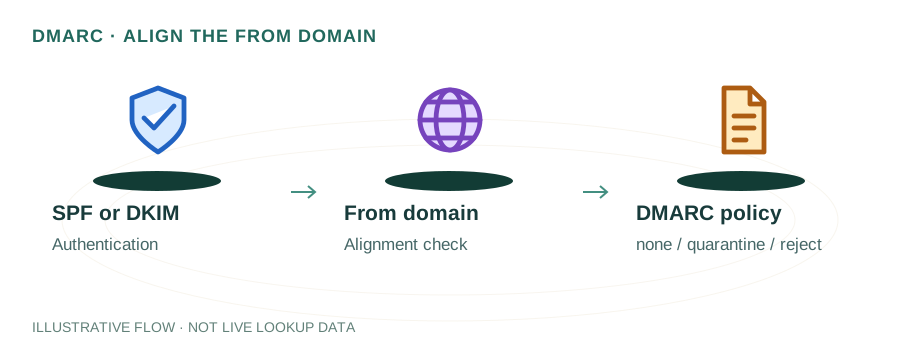
The named scenario below is a worked example for learning, not a verified incident report. Provider settings and outcomes vary.
Email Authentication Stack
Message leaves server
Checks sending IP
Verifies signature
Checks alignment
None/quarantine/reject
Inbox placement
🎯 Illustrative example: How All Three Protect Fatima's Domain
A scammer tries to send phishing email as fatima@company.com. Here's how each protocol catches it:
Scammer sends fake email
From: fatima@company.com, sent from scammer's server at IP 91.x.x.x.
SPF check runs
Receiver looks up company.com SPF record. 91.x.x.x is NOT in the allowed IP list → SPF FAIL.
DKIM check runs
Email has no DKIM signature (scammer doesn't have the private key) → DKIM FAIL.
DMARC evaluates results
SPF failed + DKIM failed. DMARC policy is p=reject.
Email rejected
Receiving server rejects the email entirely. Phishing attempt blocked. Recipient never sees it.
Fatima gets DMARC report
Aggregate report shows the spoofing attempt — IP, count, fail reasons. She can monitor threats.
SPF + DKIM + DMARC together = complete protection against email spoofing.
Any one alone has gaps. SPF without DMARC can be bypassed. DKIM without SPF can be replayed.
The Three Pillars of Email Authentication
Email was designed without built-in authentication. Anyone can send an email claiming to be from any domain. SPF, DKIM, and DMARC were created to fix this — each addressing a different part of the problem:
- SPF — Verifies the sending server is authorized
- DKIM — Verifies the message content hasn't been altered
- DMARC — Ties SPF and DKIM to the visible From domain with a policy
Side-by-Side Comparison
| Feature | SPF | DKIM | DMARC |
|---|---|---|---|
| Purpose | Authorize sending IPs | Sign message content | Policy + reporting |
| DNS Record Type | TXT on domain | TXT on selector._domainkey | TXT on _dmarc |
| What It Checks | Envelope sender IP | Cryptographic signature | SPF/DKIM + alignment |
| Survives Forwarding | No | Usually | Depends on SPF/DKIM |
| Prevents Spoofing | Partially | Partially | Yes (with reject) |
| Sends Reports | No | No | Yes |
| Standalone Useful | Somewhat | Somewhat | Needs SPF/DKIM |
SPF: Sender Policy Framework
SPF lets you publish a DNS record listing which IP addresses and servers are allowed to send email for your domain.
v=spf1 include:_spf.google.com include:sendgrid.net -allStrengths: Easy to set up, widely supported
Weaknesses: Breaks on forwarding, 10-lookup limit, doesn't check From header
Setup guide: How to Set Up SPF
DKIM: DomainKeys Identified Mail
DKIM adds a cryptographic signature to email headers. The receiving server verifies the signature using a public key published in DNS.
selector._domainkey.example.com TXT "v=DKIM1; k=rsa; p=MIGfMA0..."Strengths: Survives forwarding, proves message integrity, harder to spoof
Weaknesses: More complex setup (key generation), doesn't tell receivers what to do on failure
Setup guide: How to Set Up DKIM
DMARC: The Policy Layer
DMARC builds on SPF and DKIM by adding two critical things: alignment (the authenticated domain must match the From header) and a policy (what to do when authentication fails).
v=DMARC1; p=reject; rua=mailto:dmarc@example.com; aspf=r; adkim=rStrengths: Prevents From-header spoofing, provides visibility via reports
Weaknesses: Requires SPF/DKIM already configured, forwarding can cause false failures
Setup guide: How to Set Up DMARC
How They Work Together
Here's the flow when a receiving server processes an incoming email:
- SPF check — Is the sending IP authorized by the domain's SPF record?
- DKIM check — Does the DKIM signature verify against the published public key?
- DMARC alignment — Does the domain from SPF or DKIM match the From header?
- DMARC policy — If alignment fails, apply the policy (none / quarantine / reject)
- DMARC reporting — Send an aggregate report to the domain owner
Key insight: SPF or DKIM can pass on their own, but DMARC will still fail if the authenticated domain doesn't align with the From header.
Recommended Setup Order
- SPF first — Easiest to configure; list your sending sources
- DKIM second — Generate keys and publish DNS records for each sender
- DMARC last — Start with p=none, monitor reports, then enforce
Frequently Asked Questions
What is the difference between SPF, DKIM, and DMARC?
SPF verifies which servers can send email for your domain. DKIM cryptographically signs emails to prove they haven't been tampered with. DMARC ties them together with a policy that tells receivers what to do when authentication fails.
Do I need all three?
Yes. Each covers a different aspect. SPF alone doesn't prevent From-header spoofing, DKIM alone doesn't enforce policy, and DMARC needs at least one of SPF or DKIM to function.
Which should I set up first?
SPF first (easiest), then DKIM (requires key generation), then DMARC last (depends on the other two). Start DMARC with p=none for monitoring.