
WHOIS & RDAP Lookup Guide: Domain Registration Data Explained
Read domain registration data, identify the registrar and interpret available dates, status codes and privacy limitations.
What Is WHOIS / RDAP Lookup?
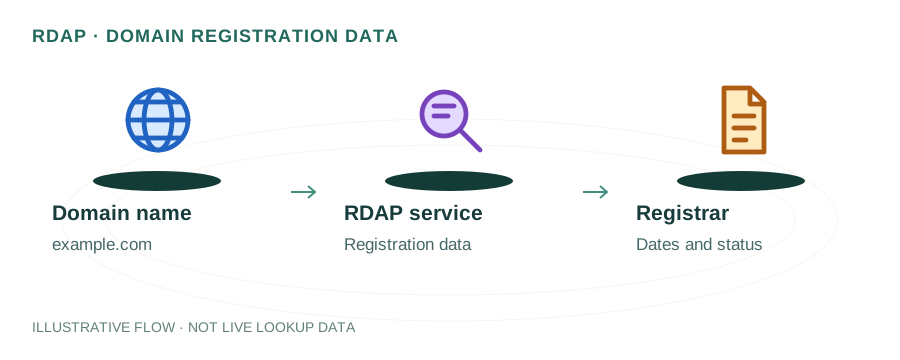
A WHOIS lookup retrieves publicly available registration information about a domain name from the domain registrar's database. This includes the registrar name, registration and expiry dates, name servers, and domain status codes.
RDAP (Registration Data Access Protocol) is the modern, IETF-standardized replacement for the legacy WHOIS protocol — it returns structured JSON data, supports internationalized domain names, and provides consistent responses across all regional internet registries (RIRs). mydnsreport.com uses RDAP to deliver accurate, real-time domain registration data.
Domain Registrar Info
Instantly see which registrar manages a domain — GoDaddy, Namecheap, Cloudflare, Google Domains, and more. This is essential when:
- Transferring domains between registrars
- Contacting the registrar for disputes or abuse reports
- Verifying domain legitimacy before business transactions
- Identifying which company controls a domain's DNS
Registration & Expiry Dates
Domain registration data reveals two critical dates:
Registration Date
When the domain was first registered. Domain age is a trust signal for search engines — older domains generally carry more authority. It also helps investigate when a potentially fraudulent site was created.
Expiry Date
When the domain registration expires. Monitoring expiry dates prevents accidental lapses that could take your website or email offline. Expired domains can be registered by domain squatters within hours.
Last Updated
When the registration record was last modified — useful for tracking DNS changes, renewals, or ownership transfers.
Name Servers
Name servers delegate DNS authority for a domain. Knowing which name servers a domain uses tells you where DNS is hosted — whether it's the registrar's default, a cloud provider like Cloudflare or AWS Route 53, or a web hosting provider's nameservers on a Linux server.
Common Name Server Patterns
| Pattern | Provider |
|---|---|
*.ns.cloudflare.com | Cloudflare DNS |
ns-*.awsdns-*.* | AWS Route 53 |
ns*.google.com | Google Cloud DNS |
ns*.domaincontrol.com | GoDaddy |
dns*.registrar-servers.com | Namecheap |
Domain Status Codes
EPP (Extensible Provisioning Protocol) status codes indicate the current state of a domain's lifecycle:
| Status | Meaning |
|---|---|
clientTransferProhibited | Domain is locked — cannot be transferred without removing the lock |
serverDeleteProhibited | Registry-level lock preventing deletion |
active | Domain is active and resolving normally |
pendingTransfer | Domain transfer is in progress |
redemptionPeriod | Domain expired and is in the grace period before release |
clientHold | Registrar has suspended the domain — it won't resolve |
When to Use WHOIS Lookup
Domain registration lookups are used daily by web hosting administrators, Linux sysadmins, domain investors, and cybersecurity professionals. Common use cases include:
- Verifying domain ownership before a purchase or business deal
- Checking if a domain is about to expire (competitor monitoring)
- Identifying the registrar for DNS management or transfers
- Investigating suspicious domains in phishing emails
- Auditing name server delegation when migrating hosting providers
- Checking domain age as part of SEO due diligence
WHOIS vs RDAP
| Feature | WHOIS | RDAP |
|---|---|---|
| Protocol | Port 43, plaintext | HTTPS (port 443), encrypted |
| Data format | Unstructured text | Structured JSON |
| Standardization | Inconsistent across registries | IETF-standardized (RFC 7482–7484) |
| Internationalization | Limited ASCII support | Full Unicode/IDN support |
| Authentication | None | Supports OAuth and access control |
| Status | Legacy — being phased out | Current standard |
WHOIS Privacy Protection
Since GDPR (2018), most registrars redact personal registrant data from WHOIS/RDAP responses. Privacy protection replaces your name, address, and phone number with the registrar's proxy information.
What's still visible with privacy enabled:
- Registrar name
- Registration and expiry dates
- Name servers
- Domain status codes
- DNSSEC status
What's typically redacted:
- Registrant name and organization
- Email address and phone number
- Physical address
FAQ
What is a WHOIS lookup?
A WHOIS lookup queries a public database to retrieve registration information about a domain — registrar, dates, name servers, and status codes.
What is RDAP and how is it different from WHOIS?
RDAP is the modern IETF-standardized replacement returning structured JSON over HTTPS, with consistent responses across all registries.
How do I check when a domain expires?
Use an RDAP lookup service to query a domain name. The results display the expiry date along with registration date and last update time.
Can I check WHOIS for any domain?
Yes — most TLDs (.com, .net, .org, .io, .in, .uk, .de, etc.) support RDAP lookups. Some privacy-protected domains show limited registrant info but registrar and expiry data is usually available.
Is this WHOIS lookup tool free?
Yes — mydnsreport.com provides free WHOIS/RDAP information with no account required.